Can We Take the Feature Again to Divide the Decision Trees
Overview
- How practice yous separate a decision tree? What are the different splitting criteria when working with conclusion trees?
- Learn all virtually decision tree splitting methods here and master a popular car learning algorithm
Introduction
Decision copse are simple to implement and as easy to interpret. I often lean on determination trees as my go-to machine learning algorithm, whether I'g starting a new project or competing in a hackathon.
And decision trees are idea for auto learning newcomers too! Simply the questions you should enquire (and should know the answer to) are:
- How do you split a decision tree?
- What are the dissimilar splitting criteria?
- What is the divergence between Gini and Information Gain?
If you are unsure almost even ane of these questions, y'all've come to the correct place! Decision Tree is a powerful automobile learning algorithm that as well serves as the building cake for other widely used and complicated machine learning algorithms like Random Forest , XGBoost , and LightGBM . You can imagine why it'south important to learn about this topic!

Modern-day programming libraries have made using any machine learning algorithm easy, just this comes at the toll of hidden implementation, which is a must-know for fully understanding an algorithm. Another reason for this infinite struggle is the availability of multiple means to split decision tree nodes adding to further defoliation.
Have you lot ever encountered this struggle? Failed to find a solution? In this article, I will explain 4 elementary methods for splitting a node in a decision tree.
I presume familiarity with the basic concepts in regression and determination copse. Here are two free and popular courses to quickly larn or castor upwards on the key concepts:
- Fundamentals of Regression Analysis
- Getting started with Decision Trees
Bones Decision Tree Terminologies
Allow's quickly revise the key terminologies related to determination copse which I'll exist using throughout the article.
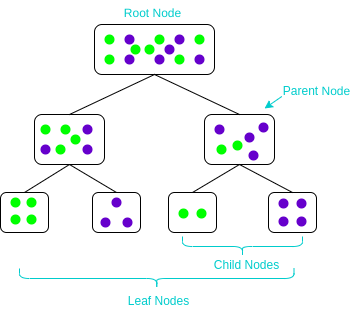
- Parent and Kid Node: A node that gets divided into sub-nodes is known every bit Parent Node, and these sub-nodes are known as Child Nodes. Since a node tin can be divided into multiple sub-nodes, therefore a node tin can act as a parent node of numerous child nodes
- Root Node: The top-most node of a decision tree. Information technology does not take any parent node. It represents the unabridged population or sample
- Leaf / Terminal Nodes: Nodes that exercise non have any kid node are known as Terminal/Leaf Nodes
What is Node Splitting in a Determination Tree & Why is information technology Washed?
Before learning whatever topic, I believe it is essential to empathise why you're learning information technology. That helps in understanding the goal of learning a concept. And so let's understand why to learn about node splitting in decision trees.
Since you all know how extensively decision trees are used, there is no denying the fact that learning about decision trees is a must. A decision tree makes decisions past splitting nodes into sub-nodes. This process is performed multiple times during the training process until only homogenous nodes are left. And it is the only reason why a decision tree can perform then well. Therefore, node splitting is a key concept that everyone should know.
Node splitting, or simply splitting, is the process of dividing a node into multiple sub-nodes to create relatively pure nodes. In that location are multiple ways of doing this, which tin exist broadly divided into two categories based on the type of target variable:
- Continuous Target Variable
-
- Reduction in Variance
- Categorical Target Variable
- Gini Impurity
- Information Gain
- Chi-Square
In the upcoming sections, we'll wait at each splitting method in detail. Let's offset with the showtime method of splitting – reduction in variance.
Conclusion Tree Splitting Method #1: Reduction in Variance
Reduction in Variance is a method for splitting the node used when the target variable is continuous, i.e., regression bug. Information technology is so-chosen because it uses variance as a measure for deciding the feature on which node is divide into child nodes.
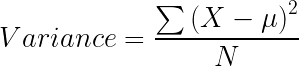
Variance is used for calculating the homogeneity of a node. If a node is entirely homogeneous, then the variance is cipher.
Here are the steps to split a conclusion tree using reduction in variance:
- For each carve up, individually summate the variance of each child node
- Calculate the variance of each split as the weighted average variance of child nodes
- Select the carve up with the everyman variance
- Perform steps 1-3 until completely homogeneous nodes are accomplished
The below video excellently explains the reduction in variance using an example:
Decision Tree Splitting Method #ii: Information Gain
Now, what if we have a categorical target variable? Reduction in variation won't quite cut information technology.
Well, the answer to that is Information Gain. Information Proceeds is used for splitting the nodes when the target variable is chiselled. It works on the concept of the entropy and is given by:

Entropy is used for calculating the purity of a node. Lower the value of entropy, higher is the purity of the node. The entropy of a homogeneous node is zero. Since we subtract entropy from 1, the Information Proceeds is higher for the purer nodes with a maximum value of 1. At present, let'south accept a wait at the formula for calculating the entropy:
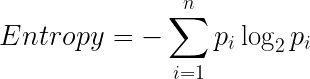
Steps to split a decision tree using Information Gain:
- For each carve up, individually calculate the entropy of each kid node
- Calculate the entropy of each split up as the weighted boilerplate entropy of child nodes
- Select the split up with the lowest entropy or highest information gain
- Until you achieve homogeneous nodes, repeat steps 1-3
Here'southward a video on how to use information gain for splitting a conclusion tree:
Decision Tree Splitting Method #three: Gini Impurity
Gini Impurity is a method for splitting the nodes when the target variable is categorical. Information technology is the almost pop and the easiest way to split a determination tree. The Gini Impurity value is:

Wait – what is Gini?
Gini is the probability of correctly labeling a randomly chosen chemical element if it was randomly labeled according to the distribution of labels in the node. The formula for Gini is:
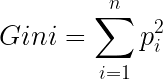
And Gini Impurity is:
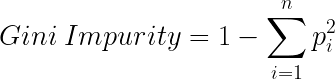
Lower the Gini Impurity, college is the homogeneity of the node. The Gini Impurity of a pure node is zero. Now, y'all might be thinking we already know almost Information Gain and then, why do we need Gini Impurity?
Gini Impurity is preferred to Information Gain because information technology does non contain logarithms which are computationally intensive.
Here are the steps to split a decision tree using Gini Impurity:
- Like to what nosotros did in data gain. For each split, individually summate the Gini Impurity of each kid node
- C alculate the Gini Impurity of each split as the weighted average Gini Impurity of kid nodes
- Select the dissever with the lowest value of Gini Impurity
- Until you attain homogeneous nodes, repeat steps one-iii
And here'due south Gini Impurity in video grade:
Decision Tree Splitting Method #4: Chi-Square
Chi-square is another method of splitting nodes in a decision tree for datasets having chiselled target values. Information technology can make ii or more than than two splits. It works on the statistical significance of differences between the parent node and kid nodes.
Chi-Square value is:

Here, the Expected is the expected value for a class in a kid node based on the distribution of classes in the parent node, and Actual is the actual value for a course in a child node.
The above formula gives u.s.a. the value of Chi-Square for a class. Take the sum of Chi-Square values for all the classes in a node to summate the Chi-Square for that node. Higher the value, college will exist the differences betwixt parent and child nodes, i.east., higher will exist the homogeneity.
Here are the steps to split a decision tree using Chi-Square:
- For each split, individually summate the Chi-Foursquare value of each child node by taking the sum of Chi-Square values for each class in a node
- Calculate the Chi-Foursquare value of each split as the sum of Chi-Foursquare values for all the child nodes
- Select the split with college Chi-Square value
- Until you reach homogeneous nodes, repeat steps 1-three
Of course, at that place's a video explaining Chi-Square in the context of a decision tree:
Stop Notes
Now, you know about different methods of splitting a conclusion tree. In the next steps, you can scout our complete playlist on decision copse on youtube . Or, you can take our complimentary form on decision trees hither .
I have also put together a list of fantastic articles on conclusion trees below:
- Tree-Based Algorithms: A Complete Tutorial from Scratch (in R & Python)
- Build a Determination Tree in Minutes using Weka (No Coding Required!)
- Conclusion Tree vs Random Woods – Which Algorithm Should yous Use?
- 45 questions to test Data Scientists on Tree-Based Algorithms (Decision tree, Random Forests, XGBoost)
If you institute this article informative, then please share it with your friends and annotate below with your queries or thoughts.
langstonenjor1974.blogspot.com
Source: https://www.analyticsvidhya.com/blog/2020/06/4-ways-split-decision-tree/
0 Response to "Can We Take the Feature Again to Divide the Decision Trees"
Post a Comment