What Conditions Must Exist for a Solar Eclipse to Occur
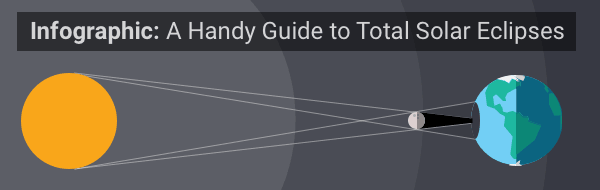
Total solar eclipses happen when the New Moon comes between the Dominicus and Earth and casts the darkest part of its shadow, the umbra, on Earth.
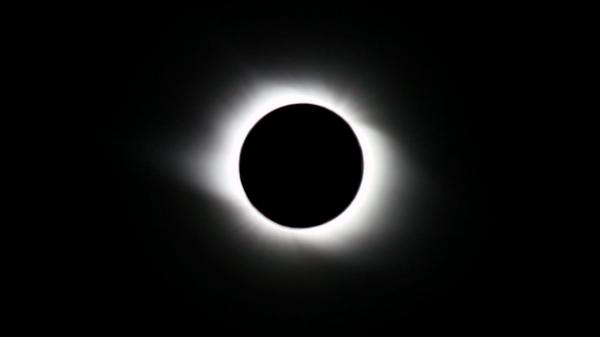
A full eclipse is spectacular to run into.
©bigstockphoto.com/mazzzur
During a total eclipse of the Sun, the Moon covers the unabridged disk of the Sun. In partial and annular solar eclipses, the Moon blocks just a office of the Sun.
Not Full Everywhere
Only viewers located in the path of the Moon's total shadow, its umbra, tin see a total solar eclipse. Those outside the path run across a partial eclipse. Past convention, therefore, eclipses are named afterward their darkest stage—if a solar eclipse is total at any point on Earth, it is called a total solar eclipse.
Hybrid solar eclipses or annular-full eclipses are an exception to this rule. This is because they change from an annular to a full eclipse or from a total to an annular eclipse along their path.
 Animation: Next eclipse in your city
Consummate Solar Eclipse Has Five Phases
There are five stages in a total solar eclipse:
- Partial eclipse begins (1st contact): The Moon becomes visible over the Sun'southward disk. It looks like the Moon has taken a bite out of the Sun.
- Total eclipse begins (2nd contact): The Moon covers the entire deejay of the Sun. Observers in the Moon's umbral path may be able to see the diamond ring result and Baily's beads just before totality.
- Totality and maximum eclipse: The Moon completely covers the disk of the Sun. Only the Sun'southward corona is visible. This is the most dramatic stage of a total solar eclipse. At this time, the sky goes dark, temperatures can autumn, and birds and animals often go repose. The midpoint of fourth dimension of totality is known as the maximum point of the eclipse.
- Total eclipse ends (3rd contact): The Moon starts moving abroad, and the Sun reappears. Those fortunate plenty to be in the Moon's umbral can see Baily's beads and the diamond band upshot merely after totality ends.
- Fractional eclipse ends (4th contact): The eclipse ends as the Moon leaves the Sun's disk.
Protect Your Eyes!
Never look directly at the Sun, eclipsed or otherwise, without proper protective eyewear. The Sun's radiations can burn your eye'southward retinas and cause permanent damage or fifty-fifty blindness.
To safely watch a solar eclipse, wear protective eclipse glasses or project an image of the eclipsed Sun using a pinhole projector.
Simply Safe during Total Eclipse
It is safe to view a fully eclipsed Sunday, totality, with the naked middle. It is also safe to find totality through cameras, telescopes, or binoculars without any special filters. Do not look at the Lord's day with naked eyes unless the Moon blocks the entire Sun. Even a small corporeality of direct sunlight can damage your eyes. Make sure yous know how long totality lasts in your location.
Unique Sights around Totality
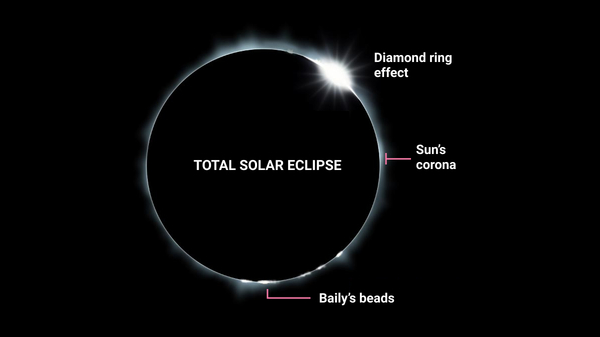
Phenomena only visible near the totality.
©bigstockphoto.com/JohanSwanepoel
Some sights are only visible during a total solar eclipse. They appear in this order as totality sets in (and in reverse gild as totality ends):
- Shadow bands: About a minute before totality, moving, wavy lines of alternating calorie-free and night tin be seen on the footing and along walls. These shadow bands are the event of Earth's turbulent atmosphere refracting the concluding rays of sunlight.
- Diamond band: Seen about 10 to 15 seconds earlier and later totality, the solar corona (the outer temper of the Dominicus) becomes visible. Together with the single precious stone of calorie-free from the Dominicus, it creates the well-known diamond band result.
- The Sun'south corona: Equally the diamond ring fades, the outermost part of the Sun's temper becomes more prominent. It is visible as a faint ring of rays surrounding the silhouetted Moon and is effectually 200–300 times hotter than the Sun's surface—its temperature can reach over 1 million °C (1.8 1000000 °F).
- Baily's beads: Nigh five seconds before totality, Baily's beads appear. They are fiddling bead-like blobs of light at the edge of the Moon created by the sunlight passing through gaps in the mountains and valleys on the Moon'southward surface.
- The Sun'due south chromosphere: The second nearly outer layer of the Sunday'due south atmosphere gives out a reddish glow. It is but visible for a few seconds right after totality.
These events and then repeat in opposite order: Get-go, the Sun'southward chromosphere reappears just earlier totality ends. The Baily's beads follow this as the Moon continues to move away. The diamond band and corona and so makes an appearance, following which shadow bands reappear earlier the crescent Lord's day is visible again.
The Science of Total Solar Eclipses
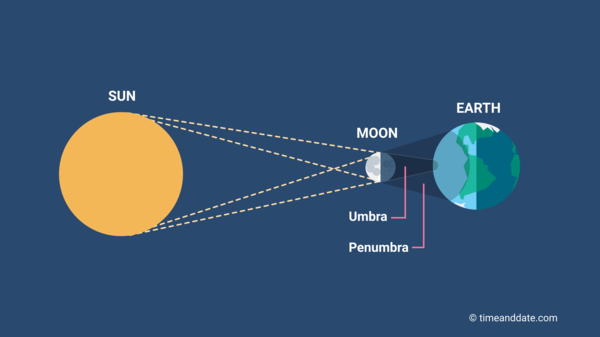
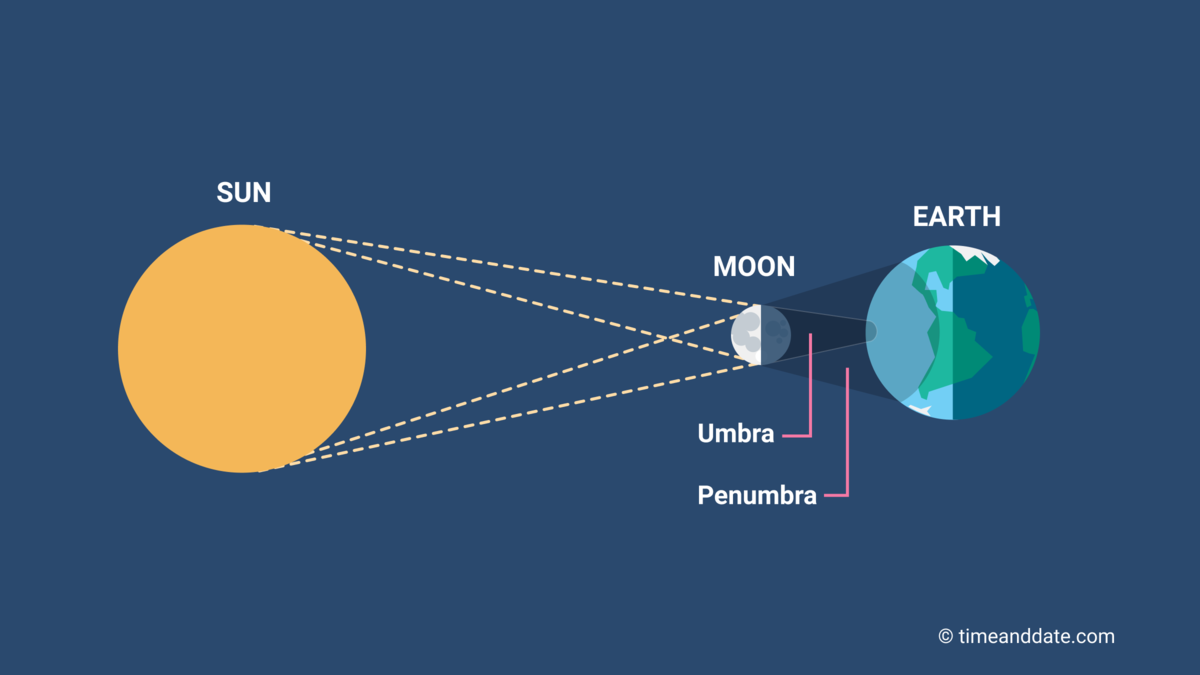
The Sun, Moon, and World are aligned
©timeanddate.com
On average, i full solar eclipse happens every xviii months, when:
- There'south a New Moon,
- at the aforementioned time, the Moon is at (or very near) a lunar node, so the Earth, the Moon, and the Sun line up in a straight (or nearly straight) line,
- and the Moon is near perigee.
Eclipse Shadows: Umbra, Penumbra, and Antumbra
Not Every New Moon
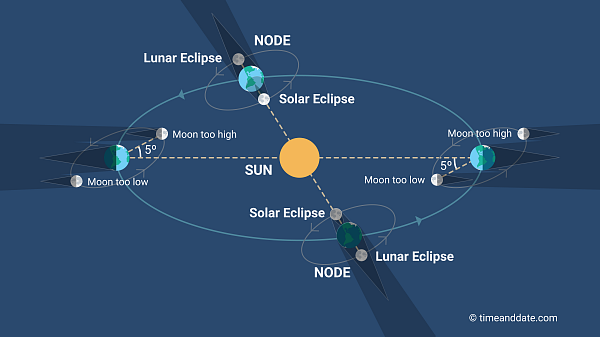
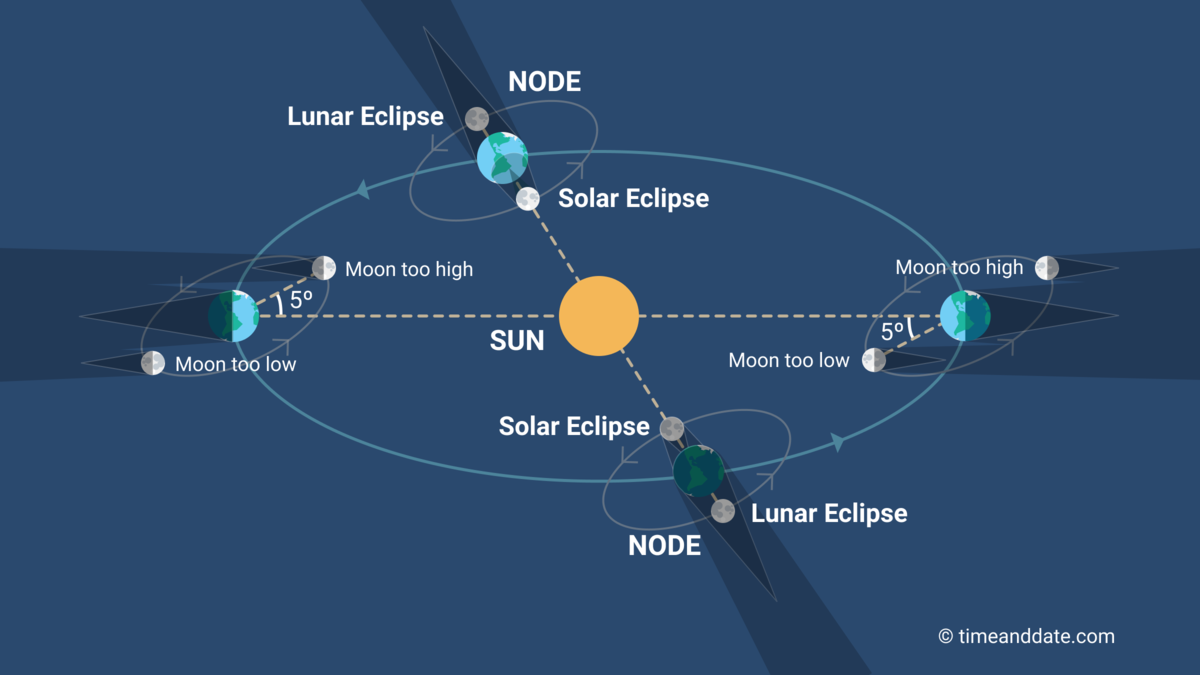
Lunar nodes are the locations where the Moon crosses the Earth'south orbital plane.
The Moon's orbital path effectually Globe is inclined at an angle of approximately five° to the Earth'due south orbital plane around the Sun (ecliptic). Without this camber, nosotros would be able to see two eclipses per lunar calendar month—a solar eclipse at every New Moon and a lunar eclipse at every Full Moon. In reality, solar eclipses happen just ii—5 times a year.
For a solar eclipse to occur, the New Moon must be at or very shut to one of the two points where the orbital planes meet. These locations are called lunar nodes.
If the Moon is not nigh a lunar node during New Moon, the Sun, Moon, and Earth do non align in a straight or almost straight line, and a solar eclipse cannot occur. Seen from Earth, the Moon passes just above or just below the Dominicus (meet image).
Moon Phases
Near Lunar Perigee
The Moon's path around World is elliptical, with one side of the orbit closer to Earth than the other. The indicate closest to Earth is called the perigee and the side uttermost from Earth is known every bit the apogee.
Earth'south orbit effectually the Sun is as well elliptical, with the Dominicus closest at perihelion, and farthest abroad at aphelion.
Earth's and the Moon's elliptical orbits mean that Globe'due south altitude from the Sun and the Moon's distance from World varies throughout the yr. It also means that from Earth, the Dominicus'due south and Moon's credible sizes alter during the yr.
When the Moon is about 400 times closer to Earth than the Sun, the Moon'due south and the Sun's apparent sizes roughly friction match. Because of this, total eclipses of the Sun can only occur when the Moon is near perigee—it is the simply time when the disk of the Moon looks big plenty to cover the entire disk of the Sun.
What if the Moon is near apogee?
How Long Does Totality Last?
A total solar eclipse can concluding for several hours and totality can range from a few seconds to 7.5 minutes. The longest total solar eclipse of the 21st century took place on July 22, 2009, when totality lasted half-dozen minutes and 39 seconds!
langstonenjor1974.blogspot.com
Source: https://www.timeanddate.com/eclipse/total-solar-eclipse.html
0 Response to "What Conditions Must Exist for a Solar Eclipse to Occur"
Post a Comment